
Skip the Salad vs. Skull King: A Trick-Avoidance Twist Fans of Grandpa Beck's Games Will Love
If you love Skull King, meet Skip the Salad: a trick-avoidance card game with the same strategic bite, a vegetable-themed twist, and zero bidding required.
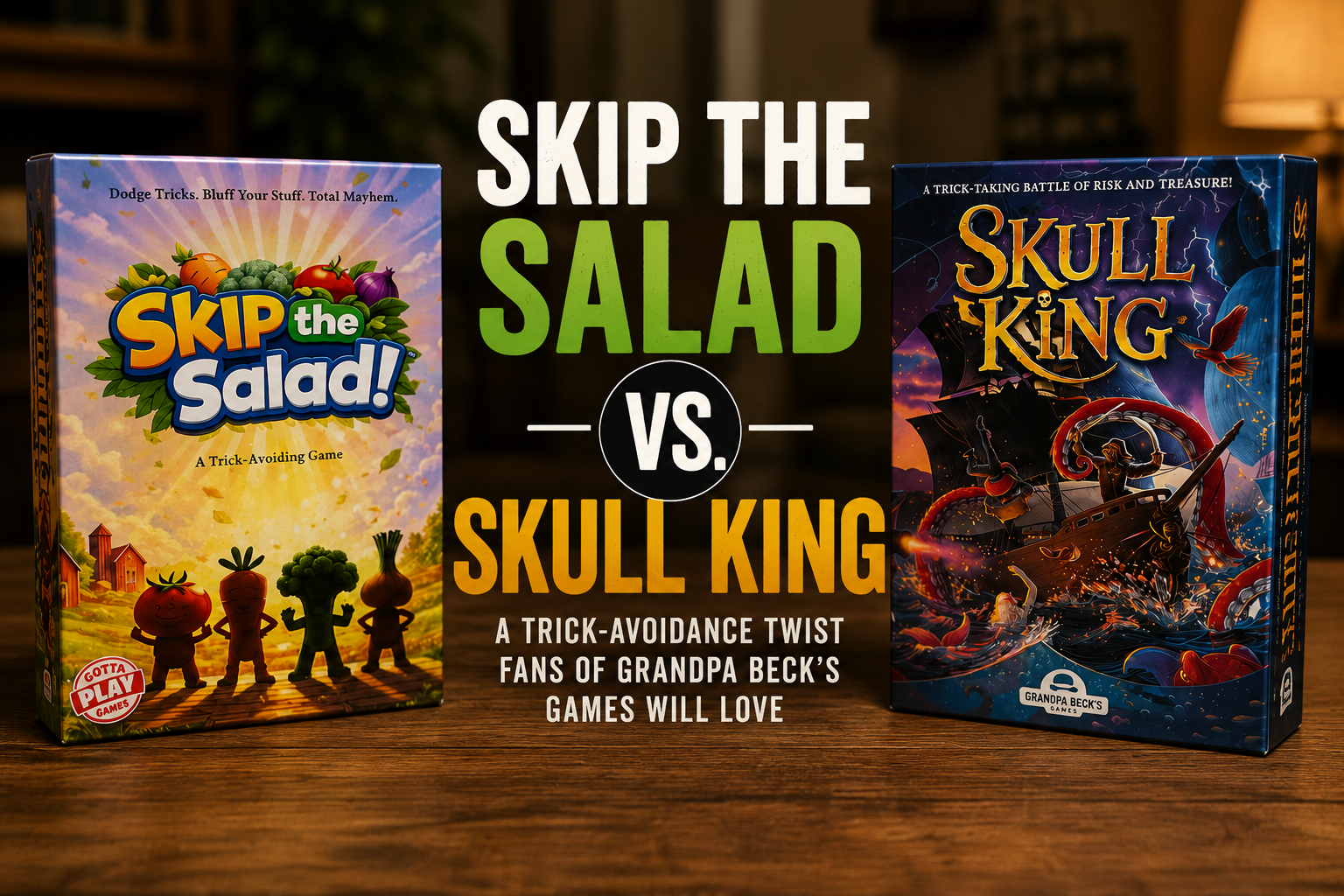
Skull King has been a fixture at our own family table for years. It's one of those games where everybody groans when someone lowballs their bid and pulls it off anyway. So when we sat down to build our first game, we already knew what we loved about that style of play: simple rules, real strategy, a little chaos from special cards, and just enough tension to keep everyone leaning in until the last card is played.
Skip the Salad, our debut card game, was built in that same spirit, but with one core mechanic flipped upside down. Instead of bidding on how many tricks you'll win, like you do in Skull King, every player is always trying to win zero. No guessing. No bidding. Just pure trick-avoidance strategy from the first card to the last.
If your family already loves Skull King, Hearts, or other games in the Grandpa Beck's lineup, there's a good chance Skip the Salad earns a permanent seat at your table too. Here's how the two compare, and why trick-avoidance fans especially are going to feel right at home.
Skull King, Briefly: The Bidding Game That Started It All
Skull King, published by Grandpa Beck's Games, is one of the most beloved trick-taking card games out there, and for good reason. It's played with a 66-card pirate-themed deck across 10 rounds, and the tension all comes down to bidding. Before each round, you look at your hand and predict exactly how many tricks you think you'll win. Nail your bid and you score points. Miss it and you pay for it.
Special cards like the Skull King, Mermaids, Pirates, and Escapes stack even more chaos on top of that bidding system. A Mermaid beats every Pirate but loses to the Skull King. The White Whale and Kraken can wreck an entire trick's worth of planning in one move. It's a formula that's earned Skull King a loyal following, ours included.
Skip the Salad: What Happens When Bidding Becomes Avoidance
Skip the Salad takes a related idea and runs it a different direction. There's no bidding phase at all. The objective for each round is already decided before the cards are even dealt: avoid winning tricks, or avoid winning specific penalty cards, depending on which round you're in.
Think of it like Skull King where every single bid is locked at zero. The whole game becomes a strategic scramble to get rid of the cards you don't want, all while trying not to accidentally win a trick you can't afford.
A few things set it apart.
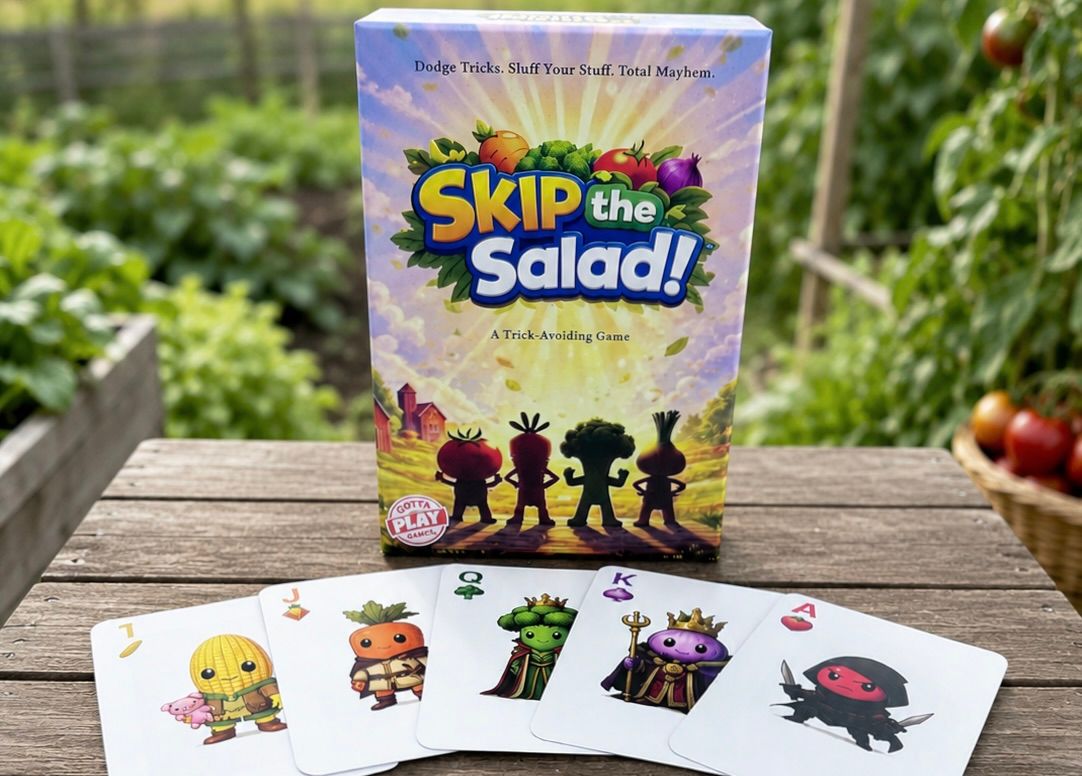
A vegetable-themed deck with real character. Instead of pirates and mermaids, our deck runs on carrots, broccoli, tomatoes, and onions, with a fifth suit, corn, that comes into play for 7 to 8 player games. Each suit climbs from low cards up through Jack, Queen, and King, topped by Assassin cards, the highest-ranking cards in the game and kept visually distinct so nobody mistakes them for a low card mid-hand. There are also Wild cards, which can be played high or low in any suit and never count toward suit-specific penalties. My son Colby actually pushed hard for the Wilds during playtesting because he felt the game needed one more layer of "what do I even do with this."
Six rounds, each with its own penalty. The base game changes its objective every round:
- No Tricks, every trick you win costs 10 points
- No Tomatoes, each Tomato card in your kitchen (that's our term for your won-cards pile) costs 10 points
- No Queens, each Queen costs 25 points
- No Onions, each Onion costs 10 points, and the King of Onions alone will run you a brutal 100
- No Last Trick, winning the final trick of the round costs 100 points
- Tossed Salad, every penalty from the previous five rounds is live at the same time
If your group wants more, the rulebook also includes five bonus rounds: No Kings, No Assassins, No Royalty, No Evens, and No High Low.
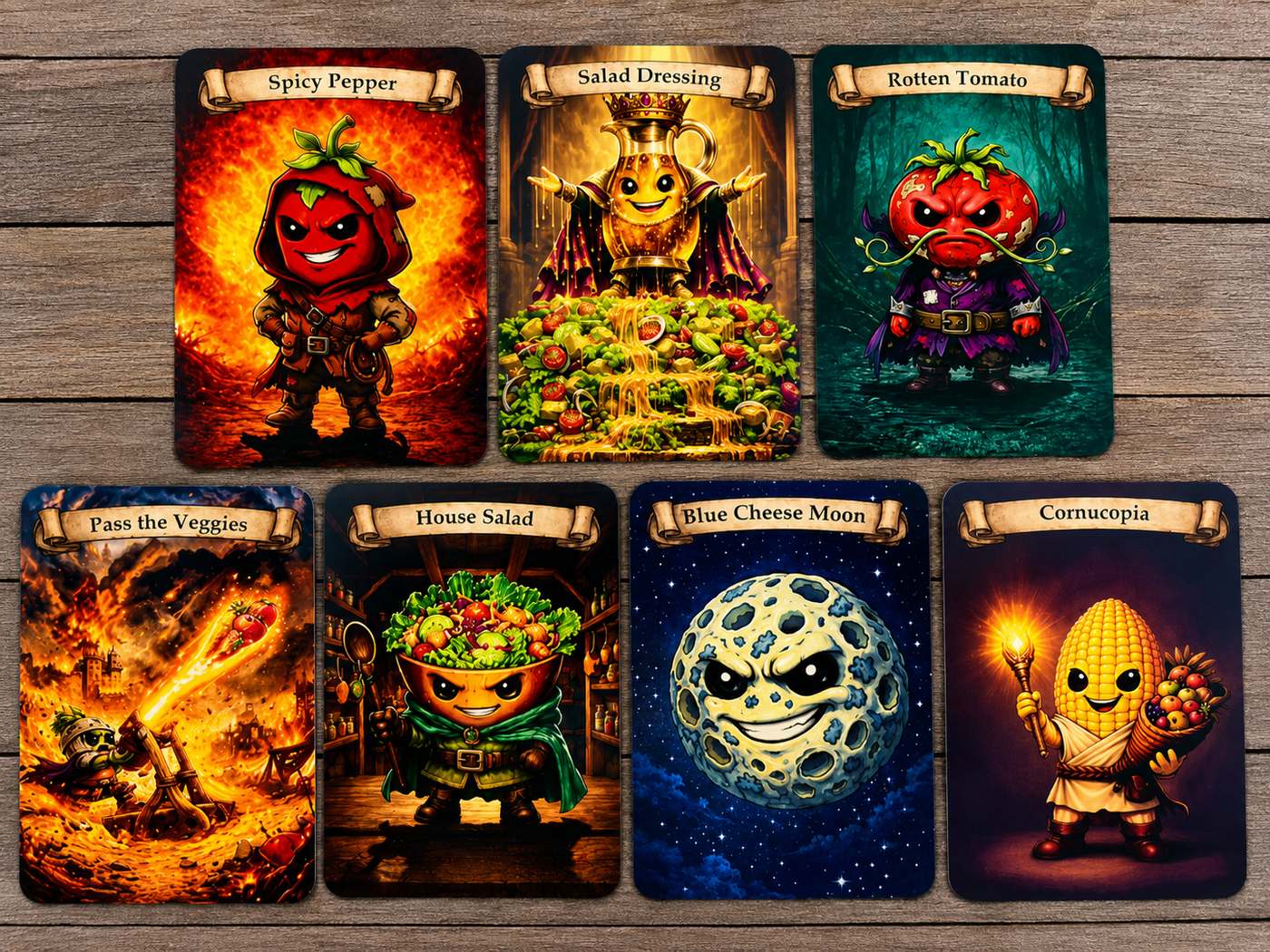
A modular "Extra Toppings" system for endless variation. This is the part our family argues about the most, in the best way. There are seven optional modules you can layer into any round:
- Rotten Tomato, a card that passes between players every time someone wins a trick with a Tomato in it. Whoever's holding it when the round ends eats a 25 point penalty.
- Pass the Veggies, everyone passes two cards to the player on their right before the round starts.
- Cornucopia, flips the entire scoring goal so the highest score wins instead of the lowest.
- Spicy Pepper, adds a trump suit, chosen each round by whoever's currently in last place.
- Blue Cheese Moon, a high-risk, high-reward rule where sweeping every available penalty in a round flips your score negative instead of positive.
- Salad Dressing, a single card that automatically wins any trick it's played in.
- House Salad, blank cards so your own group can invent and name a rule of your own. We'd genuinely love to see what people come up with.
Built to teach fast, but built to last. From the beginning, the goal was simple: a brand-new player should be able to pick up Skip the Salad in just a few minutes, while the more experienced card players at the table still have plenty to sink their teeth into. If you've ever tried teaching Skull King to someone new and watched them freeze up doing bidding math on round one, this is the part worth knowing. Skip the Salad sidesteps that entirely by taking bidding out of the equation. The base game plays 3 to 8 people in about half an hour.
Skip the Salad vs. Skull King: Quick Comparison
- Core mechanic: Skull King: Bid how many tricks you'll win. Skip the Salad: Avoid winning tricks (bid is always zero).
- Theme: Skull King: Pirates, mermaids, sea monsters. Skip the Salad: Vegetables and kitchen characters.
- Suits: Skull King: Standard suits plus special cards. Skip the Salad: Carrots, broccoli, tomatoes, onions, plus corn for 7 to 8 players.
- Special cards: Skull King: Mermaids, Pirates, Kraken, White Whale. Skip the Salad: Wild cards, Assassin cards, Salad Dressing.
- Rounds: Skull King: 10 rounds, increasing hand size. Skip the Salad: 6 rounds by default, 5 more available.
- Variability: Skull King: Fixed special-card rules. Skip the Salad: Modular Extra Toppings system, 7 optional modules.
- Learning curve: Skull King: Bidding math can trip up new players. Skip the Salad: Learnable in a few minutes.
- Player count: Skull King: 2 to 8 players. Skip the Salad: 3 to 8 players.
- Playtime: Skull King: 30 to 45 minutes. Skip the Salad: About 30 minutes.
- Publisher: Skull King: Grandpa Beck's Games. Skip the Salad: Gotta Play Games.
Why Trick-Avoidance Fans Should Give Skip the Salad a Try
If bidding games like Skull King are already your favorite corner of the trick-taking world, trick-avoidance is a natural next step, and it's one we built with that crossover in mind. You already know how to follow suit, track what's been played, and manage a hand under pressure. Skip the Salad takes those same instincts and points them somewhere new. Instead of threading the needle to hit an exact number, you're threading the needle to avoid winning at all, or to dodge whatever specific card is dangerous that round.
It's a genuinely different way to think, even though the bones of the game (following suit, taking tricks, scoring by round) will feel familiar right away to anyone who's played Skull King.
And because we built this game as a family that plays a lot of cards together, the Extra Toppings system means you're never locked into just one version. Once everyone's got the base rules down, you can start stacking in twists, or writing your own with the House Salad cards, and keep things fresh for years of game nights ahead.
About Gotta Play Games
Skip the Salad is our debut title. We're the Camp family, based in Spanish Fork, Utah: Brandon and Elena, and our eight kids. Two of our sons, Parker and Colby, are on the autism spectrum, and building this company together has been as much about creating meaningful work for them as it has been about making a game we're proud of. Card games have been the thing that consistently brings our whole family to the same table, regardless of age or interest, and we wanted to build something that could do that for other families too.
We proudly support the neurodiversity community, and Skip the Salad was designed and tested with that community sitting right at the table with us.
If you're a fan of Skull King or other trick-taking and trick-avoidance card games, Skip the Salad is available now at gottaplay.games, along with a free companion app for keeping score.
Frequently Asked Questions
- Is Skip the Salad similar to Skull King?
Yes, in structure. Both are round-based trick-taking card games with special cards that change how tricks are won. The main difference is the goal: Skull King has players bid how many tricks they'll win each round, while Skip the Salad is a trick-avoidance game where the goal is always to win as few tricks (or specific penalty cards) as possible, basically a bid of zero every round.
- What is a trick-avoidance card game?
A trick-avoidance card game flips the usual trick-taking format. Instead of trying to win tricks, you're trying to avoid winning them, or avoid winning specific penalty cards. Hearts is probably the best-known example. Skip the Salad puts a fresh spin on the format with a vegetable theme, named penalty rounds like No Tomatoes and No Onions, and the Extra Toppings system for customizing your game.
- Do you need to know how to play Skull King to play Skip the Salad?
Not at all. Skip the Salad is built to be learned in a few minutes, even if you've never played a trick-taking game before. That said, if you already know Skull King or Hearts, you'll pick this one up almost instantly.
- How many players can play Skip the Salad?
Skip the Salad plays 3 to 8 people. Games with 7 or 8 players add a fifth suit, corn, to keep the deck balanced.
- What are the Extra Toppings in Skip the Salad?
Extra Toppings are seven optional rule modules you can mix into any game: Rotten Tomato, Pass the Veggies, Cornucopia, Spicy Pepper, Blue Cheese Moon, Salad Dressing, and the customizable House Salad. They let more experienced players add strategy, chaos, or even flip the entire objective of the game, all without touching the core rules. With seven toppings to combine, there are over 125 different ways to play the game.
- What are the six rounds in Skip the Salad?
The base game runs over six rounds: No Tricks, No Tomatoes, No Queens, No Onions, No Last Trick, and a final combination round called Tossed Salad, where every penalty from the earlier rounds is active at once.