
The Rules Were Invented for the Maximum Amount of Fun: The Story Behind Skip the Salad's House Salad Card
Why we built a card called House Salad into Skip the Salad, and how one frustrated dinner-table outburst became our family's motto, and a permission slip for rule-benders everywhere.
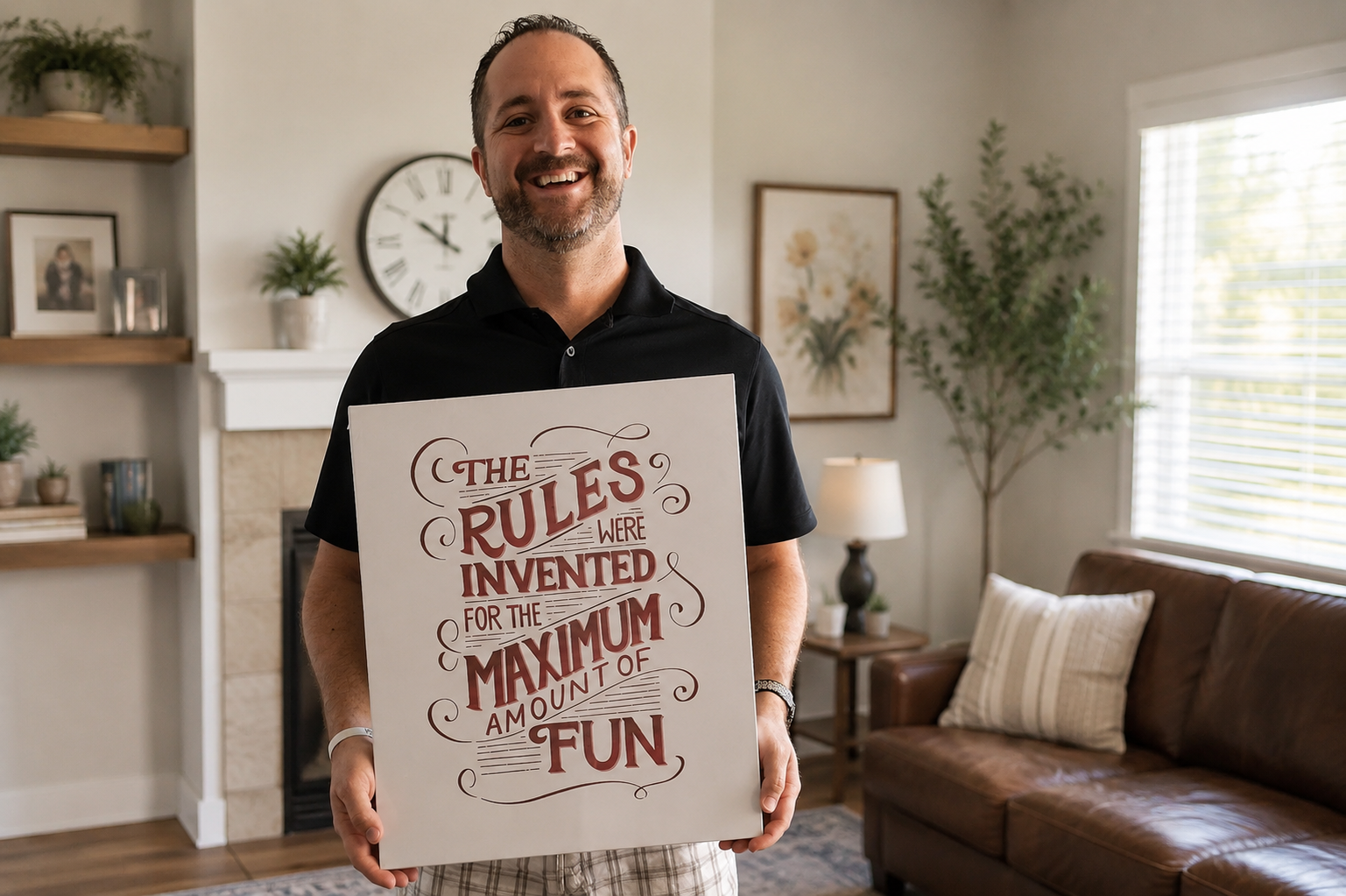
I'm a black-and-white thinker. Rules are rules. That's just how my brain works, and most of the time it serves me fine. It does not, however, serve me well during family game night.
Here's what actually happened. We were partway through a game, the kind of night where cards are spread across the table, and somebody's already accused somebody else of cheating twice, when an argument broke out over a house rule. One of my kids wanted to bend something. Another wanted to play it straight. I wanted everyone to just follow the actual rules as written, because that's what the rules are for. Voices got louder. I got more frustrated. And at some point, without really thinking it through, I blurted out:
The rules were invented for the maximum amount of fun.
I didn't mean it. Not really. It wasn't a principle I'd been sitting on, waiting for the right moment. It was just something that came out of my mouth in frustration, half nonsense, half genuine attempt to end the argument. But my kids latched onto it immediately, and it's been stuck to our family ever since. It's become a running joke. It's become a way of settling arguments before they start. Somebody bends a rule now, and someone else just says the line back, and everybody laughs, and the game keeps going.
It's a strange thing to build a company motto out of an exasperated dad-outburst, but here we are.

From a Joke to a Card
When we started designing Skip the Salad, we knew from the beginning that we wanted the game to feel like our family: a little chaotic, a lot of fun, and built around the idea that the people at the table matter more than the letter of the rulebook. So when it came time to think about how to handle house rules, the answer was obvious. We didn't just want to allow house rules. We wanted to build a card that gave people explicit permission to make them.
That's the House Salad card. It's blank. It goes into the deck like any other card, and it exists purely so your family, or your friend group, or whoever you're playing with, can write your own rule on it and bring it to life at the table.
We built it for people like me. If you're the kind of person who needs a rule to say "yes, you're actually allowed to change the rules," this card is for you. Consider it a permission slip. If your group has ever hesitated to bend a rule because it felt like cheating, House Salad exists to settle that argument before it starts, the same way that ridiculous line settles ours.
Two Blank Cards, One Very Practical Problem
Alongside House Salad, we also included two additional blank cards in every deck, and this part is less about philosophy and more about the reality of raising eight kids.
Cards get lost. They slide under couch cushions, end up in a diaper bag, or just vanish. Anyone who's ever played a card game with a full house of kids knows the moment: you sit down to play, someone starts dealing, and suddenly it's clear the Jack of Onions has gone missing, and nobody can remember when. In most games, that means the deck is compromised, and you're stuck.
We didn't want that to be true for Skip the Salad. The two blank cards mean you can write in a quick replacement and keep playing without buying a whole new game just because one card wandered off. As a family that plays a lot of card games, this felt like one of those small, practical fixes that makes a real difference over the long life of a game. We're trying to make games for families, and families lose cards. It's just what happens.
Our Own House Rules: Crouton and Side Salad
We've been testing a couple of house rules of our own using those blank cards, and both have become real favorites around here.
The Crouton Card
Here's how it works: when the game is being played in Cornucopia mode (the Extra Topping that flips the scoring so the highest score wins instead of the lowest), the Crouton card acts as the lowest-ranked card in the game. But it has one special power: it trumps the Salad Dressing card if Salad Dressing happens to be in play that round.
It's a small twist, but it changes the calculus in a mode where high cards are usually what you want. Suddenly the lowest card in the deck has a job to do, and it can undercut the single highest-ranking card in the game if you play it right. That kind of tension is exactly what we love building into this game, and it started as nothing more than a blank card and an idea someone had at our table.
Side Salad
This one came out of wanting a little more chaos, in a good way. At the start of each round, every player places one card face-down into a shared Side Salad pile. We shuffle it and lay it out alongside the other Extra Toppings in play.
During the round, on your turn, you can choose to play blind from the Side Salad pile instead of playing from your hand, even if you're holding the suit that was led. That's the part that makes it interesting: it's the only rule in the game that lets you break the normal "follow suit if you can" requirement. Once the card is played, it counts normally for scoring, penalties and all, so if you reach into the pile hoping to escape a bad hand and pull out the exact card you were trying to avoid, that's just how it goes. Every player has to play from the pile exactly once before the round ends.
It's a genuine gamble. Sometimes Side Salad bails you out of a terrible hand. Sometimes it hands you the one card you were desperately trying to dodge. Either way, it adds a layer of tension that the base game doesn't have, and it's become one of those house rules that shows up almost every time we play now.
We Want to See Yours
This is really the whole point of House Salad. We built it because we wanted families to make Skip the Salad their own, the same way our own goofy motto became something bigger than the moment it came from. Crouton and Side Salad are just the two we've landed on so far, and we're always tinkering with new ones. If your family has cooked up a house rule using your blank cards, we'd genuinely love to hear about it.
Send us your rule, your card name, or a picture of it in action. Tag us on social media or drop us a line at [email protected]. We might just feature it, and who knows, your family's house rule might end up being someone else's new favorite way to play.
About Gotta Play Games
Skip the Salad is our debut card game, built by the Camp family of Spanish Fork, Utah: Brandon and Elena, and our eight kids. We started this company because card games have always been the thing that got our whole family to the same table, and we wanted to build something that could do the same for other families. Two of our sons are on the autism spectrum, and creating meaningful work for them has been just as much a part of this journey as making a game we're proud of.
Skip the Salad is available now at gottaplay.games, including the House Salad card, two blank replacement cards, and a rulebook that genuinely wants you to bend it a little.
Frequently Asked Questions
What is the House Salad card in Skip the Salad?
House Salad is a blank card included in every Skip the Salad deck that lets players create and name their own house rule. It's designed to give players explicit permission to customize the game to fit their own family or group.
Why does Skip the Salad include blank cards?
Skip the Salad includes two blank cards for two reasons: to support the House Salad house-rule system, and to serve as a practical replacement if a card is ever lost or damaged, which is a common problem for families with young kids.
What is the Crouton card house rule?
The Crouton card is a house rule created by the Camp family using one of the blank cards included in Skip the Salad. When playing in Cornucopia mode, the Crouton card acts as the lowest card in the game but trumps the Salad Dressing card if it's in play that round.
What is the Side Salad house rule?
Side Salad is a house rule where each player contributes one card face-down to a shared pile at the start of the round. On your turn, you may play blind from that pile instead of your hand, even if you're holding the suit that was led, breaking the game's normal follow-suit rule. Each player must play from the pile exactly once before the round ends, and whatever card comes up counts normally for scoring.
Can I make my own house rules for Skip the Salad?
Yes. The House Salad card and the two additional blank cards are specifically included so players can invent, name, and play their own house rules. Gotta Play Games invites families to share their house rules directly with the company.